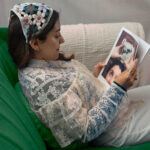
Throughout the ages, women reading have often been the subject of paintings. This simple act of showing women engaging in a leisure activity often has had deeper connotations than what we might realize today: In the past and at different historical eras, education was reserved for only women of wealthier classes, seen as preparation for marriage, and viewed as dangerous.
Paintings of women reading — often painted by men, and sometimes by women — give the viewer varying ranges of ability to gaze upon the subjects during private moments where a woman has a book in her hands, sometimes with the woman looking back at the subject, sometimes with her turning away and sometimes with her oblivious to the viewer at all. Through these viewpoints, artists make a variety of statements, offering their commentary on the appropriateness and purpose of the task.
In light of these layers of meaning, let’s not forget that women’s opportunities and abilities to read freely in the current moment — and our ability to dismiss images of women reading as mundane — have been hard-won by those who have lived before us; let’s exercise our right to read remembering that still today, many women around the world are not able to read, accounting for ⅔ of approximately 781 million people who are illiterate globally, according to the National Literacy Institute.
Here, we recreate the painting “Girl Reading Letter by Candlelight With Young Man Peering Over Her Shoulder,” by Joseph Wright of Derby, c. 1770s by reimagining it in the present day. May this photo help us to reflect on the ways we read now and how that has changed throughout the decades, and inspire us to continue to take up this privilege to think, to enjoy, to connect, making the world and ourselves better through the free and open exchange of ideas and perspectives.

Tell us about your relationship with reading.
Reading isn’t something I do constantly, but when I do read, it’s something that helps me grow in my faith or creativity. Reading, for me, isn’t just a hobby or a habit; it’s a way to step into other stories and learn more about life, people and purpose.
Why do you read? What do you read most often?
I read for a purpose and to find perspective. Whether it’s during my Bible time, watching a film or reading through a story outline, I love when words help explain things that aren’t easily explained.
What is a text that has impacted your life or the way you view the world, and how has it changed you?
A text that has deeply impacted my life is Jeremiah 29:11 (NIV): “‘For I know the plans I have for you,’ declares the Lord, ‘Plans to prosper you and not to harm you, plans to give you a hope and a future.’” I had heard this verse many times before, but I didn’t fully understand it until I saw how God’s plan for me was unfolding — especially through the challenges and blessings that shaped who I am today.
What are three pieces of writing you recommend to others?
The Bible, where hope, peace and answers can be found. “Oceans (Where Feet May Fail)” by Hillsong UNITED, because the lyrics remind me to keep my focus on God during the chaos of the storm. “My Life With the Walter Boys” by Ali Novak, because it’s a story about learning to start over, friendship and family, and it reminds me how powerful storytelling can be.
What is your favorite line from a book?
“You couldn’t control everything, because it wasn’t all meant to be perfect. Sometimes, things needed to be messy.” — From “My Life with the Walter Boys” by Ali Novak
It’s a reminder I can’t have it all perfectly together like I would like, but that’s OK — it wasn’t meant to be that way.